
Ash dieback has changed the look of our countryside in little more than a decade, If you live in Kent, you’ve almost certainly seen it: ash trees with thin, patchy crowns, bare twiggy tops and clumps of leaves sprouting from the trunk and it’s one of the most common diseases in Kent trees.
As a tree surgeon in Kent, we deal with ash dieback on a regular basis. Here we answer the questions we’re asked most often what it is, where it came from, how quickly it kills trees, and what you can actually do about it.
What is ash dieback?
Ash dieback is a disease of ash trees caused by a fungus called Hymenoscyphus fraxineus (you may also see its old name, Chalara fraxinea, which is why it’s sometimes called “Chalara”). It hits our native common ash (Fraxinus excelsior) particularly hard.
The fungus attacks the leaves first, then spreads into the shoots and branches, where it causes lesions in the bark that cut off the flow of water and nutrients. Over time the crown dies back from the tips inward- hence the name.
Signs to look out for:
- Leaves developing dark brown or black patches and wilting in mid to late summer (July to September)
- Dead twigs and branches, especially in the upper crown
- Diamond-shaped, dark lesions on the bark where side shoots meet the stem
- Bunches of new shoots growing from the trunk or lower branches (epicormic growth) as the tree tries to compensate
- A thin, sparse crown that lets far more light through than a healthy ash
Identifying it in autumn and winter is harder because even healthy ash trees drop their leaves early, If you’re unsure, a professional inspection is the best way to know where you stand.
Where has ash dieback come from?
The fungus is native to East Asia, where local ash species evolved alongside it and only suffer mild symptoms. European ash has no such natural defence.
The disease was first noticed in Poland in the early 1990s, and is thought to have arrived on ash imported from Asia. From there it spread west across Europe, causing heavy losses in countries including Denmark.
In the UK it was first confirmed in February 2012, on young trees at a nursery in Buckinghamshire that had been imported from the Netherlands. By October 2012 it had been found in established woodland in Norfolk, and the government banned imports and movements of ash trees that same month. Researchers now think the fungus may have been here for some time before it was officially spotted, carried both on infected nursery stock and as spores blown across the Channel.
Today it’s found across England, Scotland, Wales and Northern Ireland.
How does it spread, and how long does it take to infect a tree?
Ash dieback has a yearly cycle that’s closely tied to fallen leaves:
The speed of decline depends heavily on the age and situation of the tree:
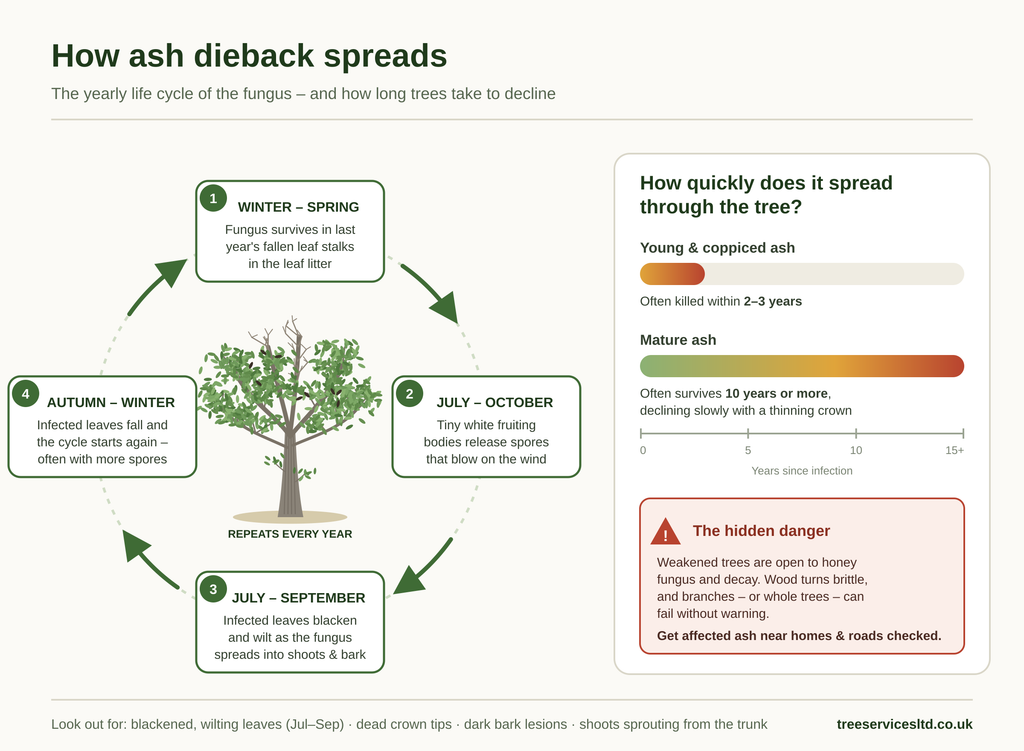
The real danger with older trees is what happens alongside the disease. A stressed ash is far more vulnerable to secondary problems such as honey fungus and other decay fungi, which attack the roots and base of the trunk. It’s often this combination that kills mature trees and makes them unstable. Ash affected by dieback becomes brittle, and branches or even whole trees can fail without much warning.
Can ash dieback be prevented?
There is currently no reliable way to prevent ash dieback or protect an individual tree from it. Because the spores travel on the wind, you can’t stop them reaching your garden.
That said, there are sensible steps that help slow the spread and reduce the spore load around your trees:
- Clear and dispose of fallen ash leaves in autumn, rather than leaving them under the tree — this removes the material where the fungus survives the winter.
- Don’t move leaf litter or ash plants from site to site.
- Clean boots, tools and vehicle tyres if you’re walking or working between woodlands.
- Plant a mix of species rather than relying on ash, so your garden or land isn’t over-reliant on one tree.
- Buy trees from reputable UK nurseries that follow plant health rules.
What is the treatment for ash dieback?
There is no cure or chemical treatment for ash dieback. No spray, injection or feed will reverse an infection, so be wary of anyone who claims otherwise.
Instead, treatment means managing the tree so that it stays safe for as long as possible:
- Assessment and monitoring. A qualified arborist can assess how far the disease has progressed, check for decay at the base and roots, and judge how much risk the tree poses to people, buildings, roads and power lines. Trees near homes, footpaths and highways need checking regularly.
- Retain where safe Not every infected ash needs to come down. Around 1–2% of ash trees appear to have some natural tolerance, and keeping healthier trees standing helps the species recover in the long run.
- Crown Reduction Removing dead and dying branches, or reducing the size of the crown, can lower the risk and extend the life of a tree that’s only mildly affected.
- Pollarding can be a good alternative to felling like these affected Ash Trees pollarded in Kent. The crown is cut back to a framework of main branches, and the tree then grows a fresh crown from those points. Pollarding takes out much of the brittle, dying crown whilst the trunk, roots and wildlife value are kept, and the tree has the chance to grow back a healthy new crown.
- Felling or Removal or Removal Where a tree is badly affected and close to a target, tree removal is often the safest option. Because diseased ash becomes brittle, climbing these trees can be dangerous and machinery is required.
Do I need permission? Trees in private gardens are generally exempt from needing a Forestry Commission felling licence, but ash in woodland usually needs one unless the trees are dead or pose a real and immediate danger. Tree Preservation Orders and conservation area rules still apply, so check with your local council first or use this free TPO checker and if your unsure, we’re happy to help!
It’s also worth knowing that, as a tree owner, you have a duty of care to make sure your trees don’t put people or property at risk. If an ash on your land is showing signs of dieback, it’s sensible to get it looked at sooner rather than later.
Why is ash dieback particularly bad in Kent?
Kent has been one of the hardest-hit counties in the country, for several reasons:
- Ash is everywhere here. Ash is the most common tree in Kent, making up almost a fifth of all trees in the county. There are an estimated half a million ash trees on private land alone, plus around 20,000 on land managed by Kent County Council.
- We were among the first. Kent was one of the first areas of England to be badly affected. The disease has simply had longer to take hold here than in many other parts of the UK.
- Our closeness to the continent. As the corner of England nearest mainland Europe, Kent is well placed to receive wind-blown spores from infected areas across the Channel.
- Lots of ash woodland. Woodland gives the fungus ideal conditions, plenty of leaf litter, shade and humidity and much of the Kent Downs and the Weald is rich in ash.
- High levels of infection. Kent County Council monitoring has found that around half of the county’s ash trees are now showing signs of the disease.
The result is a huge number of declining ash trees next to roads, railways, footpaths, schools and homes, which is why councils and landowners across Kent have been prioritising safety work on ash for several years.
Worried about an ash tree?
If you’ve spotted any of the signs above on an ash tree at your home or on your land, our team can inspect it, explain your options and carry out any work needed safely. From deadwood removal and crown reductions through to felling and stump grinding.
And nothing goes to waste: timber from our tree surgery work across Kent is seasoned and sold as hardwood logs, available in bulk bags and loose loads.
Get in touch for a free, no-obligation quote.